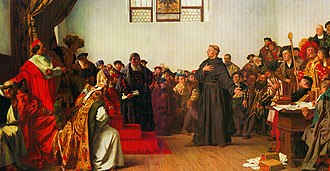
One aspect of Berlin history that I found interesting was the
diversity of the city. I was not aware of how diverse the city had become
throughout the 20th century. As Matt Frei explained in the BBC
documentary, “East Berlin became a place of asylum for North Vietnamese
communists.” He explained it as a dreamland and a paradise for the Communist North
Vietnamese, as they were welcomed with opened arms by the Communist East
Berliners who shared the same political views as them. Another hint of
diversity was present in West Berlin, where Turks were invited to help rebuild
the city. Frei said that over 100,000 Turks now call themselves Berliners.
Also, not only is Berlin diverse in foreign peoples, it also has a diverse
German population. During the 1970’s, West Berlin authorities offered a free
pass from military service to young German men who moved to Berlin. In this
time, Berlin became a city of anarchists, political radicals, and all kinds of
outsiders. Berlin had become a diverse city with a mix of foreign nationals and
domestic outcasts.
 |
Diversity in Berlin is still extremely prevalent. Turks form
the largest ethnic minority group living in Berlin, with numbers nearing
200,000. Berlin holds the largest Turkish community outside of Turkey.
|
A second aspect of Berlin history that I found interesting was just how exceptionally rich, yet extremely tumultuous its past has been. However, Berlin seems to bounce back and rebuild, no
matter how destructive its past has been. Following the Second World War, Berlin
was in ruins. Much of the city was ruined by the destructions of war. As Matt
Frei states, “the war was over, but so was Berlin.” Also, British Air Marshal
Arthur Tedder compared Berlin to a ruined classical city, and in his opinion, the
city would never be rebuilt. Citizens of Berlin had a different opinion.
Following the war, Berlin began a reconstruction that would last decades. Immediately
after the war, Frei explains “control of the city had been divided, with the
Russians in charge of the east, and the west controlled by the Americans, the
British, and the French. In effect, there were now two Berlins, east and west.”
Both sides began reconstructing their city, in competition with each other.
Again, Frei explains the city’s determination to rebuild, “Berlin is a city
that simply won’t give up. A succession of new, old buildings keep appearing. They
acknowledge, rather than deny, their history.” Both deconstruction and reconstruction seem to
be a basic part of Berlin’s past, and one is just as “politically charged” as
the other. Matt Frei says this demolition is the curse of the city, as we have
seen from its ruinous past.
.jpg) |
An aerial view of Berlin, with the Brandenburg Gate in the
foreground. The city lay in ruins following the conclusion of World War II.
|
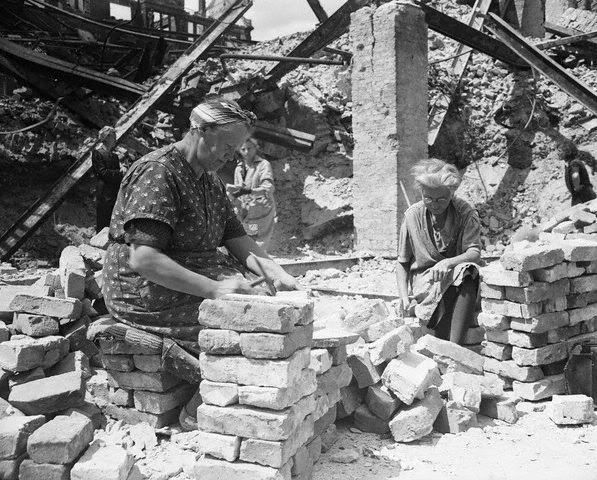 |
German women doing their part in helping rebuild Berlin. It
would be many years before Berlin would recover from the war-times destruction,
but it could not have been done without the hard work of many of its citizens.
|
Finally, the third aspect of Berlin history that I have found interesting includes East Berlin and the Berlin Wall. Berlin,
1961, construction of the Berlin Wall began. Its purpose was to separate East
Berlin, communist Berlin, from West Berlin, capitalist Berlin and to keep
refugees from fleeing to West Berlin. Berlin became “suspended between two
regimes, two ideologies, two halves of the world.” East Berlin would exist
under communist Soviet rule for several decades. Finally, on the night of November
9, 1989, Berliners began dismantling the Berlin wall. The bringing down of the
wall and the opening of East and West Berlin put an “end to the cruelties of
the Cold War.” That night in November was unplanned, unanticipated, and unknown
to those running the country. It was a completely unexpected event that would
change the world. Since that night of the destruction of the Berlin Wall, Berlin
has been put back together as a city, and Germany as a country. As one
interviewee states, “The division of Germany was all the division of Europe,
and the unification of Germany was the unification of Europe.” With the
destruction of the wall came a consolidation of East Berlin and West Berlin,
and hostilities between the two was over. Further incorporation would take
place as the German government would work to reintegrate the two halves of the
city. While it is still possible today to tell East Berlin from West Berlin,
the two have formed together to create one the most beautiful, thriving cities
of Europe.
 |
Ampelmännchen, or “little traffic
light men” are one of few East Berlin symbols that have survived the
unification of Berlin. These symbols can be found not only on traffic lights,
but also on T-shirts, key chains, and the like as a commemorative and symbolic type
item.
|
*All quotes are used from the Berlin History BBC Documentary
Word Count: 672