Monday, November 10, 2014

Germany's Political Diversity: 1914-1945

The history of Germany’s government is an extensive and complex one. Leadership roles, the political structure, and the variety of political parties varied drastically throughout the nineteenth and twentieth centuries. However, Germany’s identity would not be what it is today without these numerous changes throughout its history. Hagen Schulze described that “In the German political tradition, parties were symbols of narrow special interests, political infighting, and threats to national unity” (Schulze, 191). During the First World War, the Weimar Republic was formed, creating the first democracy of Germany.  Following World War I, a political war erupted as political parties struggled for power. Hagen Schulze wrote, “After Germany’s collapse, the situation was volatile, with three different factions vying for power” (Schulze, 198). The Treaty of Versialles, created by the Allied forces, set Germany upon a destructive course politically and economically. With the treaty, “Germany was placed under legal sanctions, deprived of military power, economically ruined, and politically humiliated” (Schulze, 204).


The Coat of Arms of Germany between 1919 and 1928, the period during which the Weimar Republic controlled.

Throughout the late 1910’s and early 1920’s, Germany’s political party system frequently went through changes. The SPD, Center Party, DDP, DVP, and several other political parties witnessed the recurrent change of governments. Hagen Schulze wrote, “The republic experienced a succession of sixteen different governments, on the average a new one every eight-and-a-half months” (Schulze, 207). However, the “golden years” of the Weimar Republic would soon approach, a period with little political conflict. Schulze described that this positive tone of the era was due to new governments in both Britain and France, which were much more open to German wishes and hardships. “With these measures, the long, dark shadow of the postwar years . . . finally receded. The catastrophe had lasted from 1914 to 1923, but now Germany and Europe as a whole were emerging from the darkness and entering into a long period of peace and returning prosperity” (Schulze, 212-3).
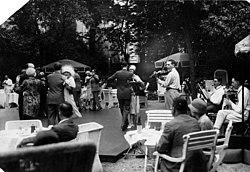
A jazz band plays for a tea dance, 1926, Berlin. The time period known as the "golden years".

Germany and the rest of Europe entered a period of peace that would last until the next decade. Between 1924 and 1929, German production increased in volume by 50 percent. Unfortunately, other sections of Germany’s economy did not fare as well. The gross national product would not reach the prewar level of 1913 until 1927, when it only began to decline again. The unemployment rate was much higher than the prewar years, and “labor productivity figures stagnated, without ever returning to prewar levels” (Schulze, 219). Eventually, in 1930, Chancellor Hermann Müller resigned from his position, leading to the last parliamentary government of the Weimar Republic to come to an end. Hagen Schulze described by writing, “The failure of the republican parties to reach a workable consensus was symptomatic of the overall political collapse of the republic, which broke apart into factions at war with one another” (Schulze, 230). A new party would soon enter the playing field of the German political realm; one which would attract a vast following but also lead to Germany’s central role in the Second World War.


Hermannmueller.jpg
Hermann Muller, 12th Chancellor of Germany. His resignation would lead to the last parliamentary government of the Weimar Republic to come to an end.


Adolf Hitler’s National Socialist German Workers’ Party (NSDAP) would pick up steam throughout the 1930’s, gathering more and more of a following, young and old. “On January 30, 1933, he [Hindenburg] appointed Hitler chancellor, sounding the death knell for the republic of Weimar” (Schulze, 243). The Weimar Republic was dead after a fourteen year control and by mid-1933, “only one party existed in Germany, the party of Adolf Hitler” (Schulze, 249). Hitler’s Nazi Party would quickly begin their reign over Europe, starting military actions in 1939, the beginning of World War II. The war was not all good for Germany and its people. Hagen Schulze explained,

The war intensified the tendencies of the totalitarian state, bringing with it a militarization of public life, increasing organization of the formerly private sphere, and social leveling . . . There were appeals to solidarity within the ‘community of the people’; party and state organizations were created that included virtually every citizen in the end; block wardens kept an eye on their neighborhoods, and neighbors were encouraged to spy on one another.(Schulze, 270)


World War II caused many changes in Germany. At the end, yet another German political party saw its death. Germany and its people now faced a long period of reconstruction, in physical, mental, and political form. The nation would be divided between the four major allied powers, and would face centuries of division between themselves. Overall, Germany has gone through an almost countless number of political changes throughout its history. Without the political structure and the party system’s drastic changes throughout its history, Germany would not be the nation it is today.


The emblem of the NSDAP, the Nazi Party

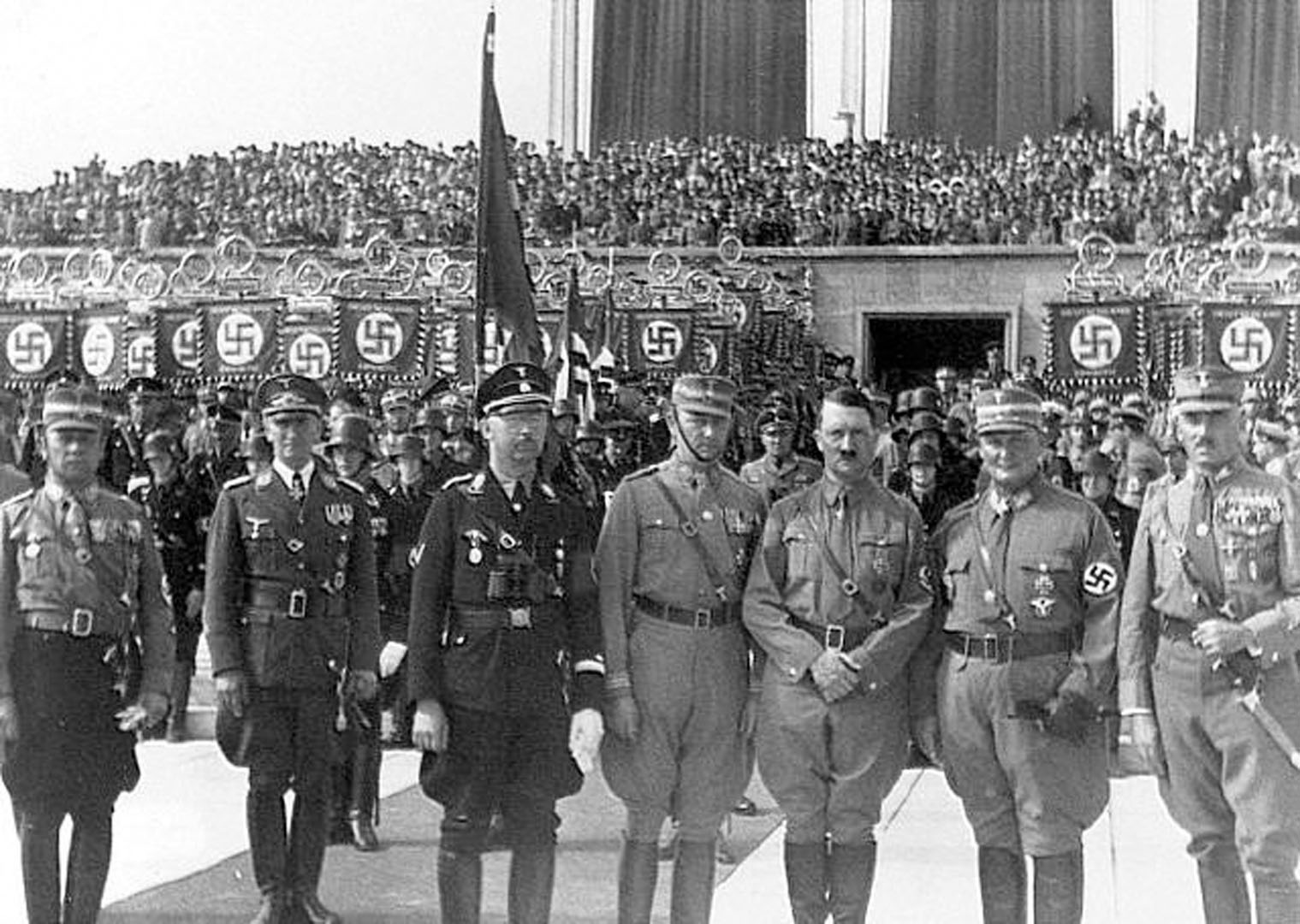
Hitler along with other Nazi officials, including Goering and Himmler at a Nazi Party Rally in Nuremberg.


Word Count: 763

Tuesday, October 21, 2014

Germany's Growth, Evolution, and Founding between the Seventeenth and Nineteenth Centuries

The German state was founded over a broad period of time which consisted of several wars, leadership disputes, dynasty battles, border conflicts, and many other quarrels. It wasn’t until 1871 when the German state was ultimately founded. However, there are records of there being an idea of a German state as early as the seventeenth century, when in 1656 political philosopher Ludwig von Seckendorff declared that “a ‘German nation’ existed in the political sense” (Schulze 86).  Additionally, “In the seventeenth and eighteenth centuries ‘German’ still referred only to a language, nothing more, and at times even the prospects for its future were murky (Schulze, 86). Hagen Schulze described in Germany: A New History that the national boundaries in Europe shifted so often, as a result of major wars, that whole provinces and even empires changed hands (Schulze, 81). This “shifting of hands” is a compelling issue which led to Germany’s vast cultural and political diversity that would evolve throughout the seventeenth, eighteenth, and nineteenth centuries. Also, various wars during the 18th century, including both the first and second Silesian Wars and the Seven Years’ War, altered the path of Germany’s future. “After the Seven Years’ War, it might have appeared as if the world of German states had broken free from the empire to a large degree and caught up with their neighbors in the European system as sovereign powers capable of political action” (Schulze, 84). These small states and their distinctiveness are what led to Germany’s complex and distinguishing identity today. Hagen Schulze writes, “The nation grew, in fact, precisely because of its fragmented identity and the practical requirements of a multitude of small states and governments” (Schulze, 89). German identity would only evolve more as the nation grew.

The Battle of Hochkirch, October 14, 1758 during the Seven Years' War.

Early in the nineteenth century, on July 12, 1806, sixteen states in south and southwestern Germany signed an act which abolished any connection they had with the empire and established a protectorate under Napoleon (Schulze, 99). This act may be seen as one of the major points in Germany’s history. Before this point, Germany had been doubtful without the protective covering of the empire. The French were now making their way through Germany, causing devastation as they pillaged the land. Philosopher Johann Gottlieb Fichte delivered his “Addresses to the German Nation” in occupied Berlin during the winter of 1806-1807. In the addresses, he declared that “the nature of the German people was genuine and unspoiled, and that by fighting for their own identity and freedom from French military and cultural domination, Germans were serving the cause of progress” (Schulze, 104-5). During this time, Germans were fighting for their identity; their identity which had been continuously undefinable. War would eventually cease, following the Wars of Liberation in 1813 and 1815, and Germany would enter a phase called Biedermeier. This period lasted two decades and was a time when there was no war in Europe.

Napoleon Bonaparte (1769-1821), Emperor of the French and de facto ruler of all western and central Europe. 

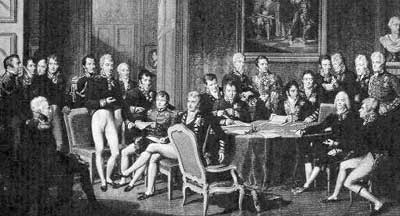
The Congress of Vienna
"A Break in Negotiations at the Congress of Vienna: In the fall of 1814 representatives of the European nations met in Vienna to decide on a new order for Europe - including Germany - after Napoleon's downfall."
A German Reading Room. During the phase called Biedermeier, literacy rates rose to nearly half - "a true revolution."

In 1840, there was a “rebirth of German nationalism and strong growth in the organizations promoting it” (Schulze, 119). On October 10, 1847, “leaders met in Heppenheim and issued a demand for a federal German state with a strong central government that would be answerable to parliament” (Schulze, 121). Later, on May 18, 1848, “the German National Assembly – 585 elected representatives – convened in Frankfurt to draft and adopt a constitution that would guarantee basic freedoms and to elect a national government” (Schulze, 124). One problem that arose during this time was deciding which regions would be part of the new Germany. Two possible solutions emerged; one being Groβdeutschland, “Great Germany,” which would consist of all German regions including Austria and be headed by a Hapsburg emperor. The second solution was called Kleindeutschland, “Small Germany.” This would exclude the Austrian areas and be ruled by a Hohenzollern emperor. Unfortunately, the Revolution of 1848-49, for the most part, would eventually fail. However, the following two decades would consist of another rebirth of German nationalism. The German National Association (Small Germany) and the German Reform Association (Greater Germany) were formed in 1859 and 1862, respectively. Then, in 1866, war ended. Schulze explains “The war that ended at Koniggratz has been seen in retrospect . . . as a step toward German unity (Schulze, 141). The Treaty of Prague ejected Austria from Germany and created the North German Confederation. The Franco-Prussian War of 1870-71 would lead to German victory, concluding on May 10, 1871. “Political unification of the allied German states proceeded in tandem with the events of the war” (Schulze, 144). Finally, southern Germany joined the North German Confederation and formed a German Empire.

German unification by no means came about solely on orders from above, from the ruling princes and their governments, but also as a result of clamor from below, from the forces of the liberal, middle-class national movement, and the result was accordingly not a Great Prussia but a German Empire. (Schulze, 145)

The Frankfurt National Assembly in St. Paul's Church (c. 1848)
The German National Assembly - 585 elected representatives - convened in St. Paul's Church in Frankfurt to draft and adopt a constitution that would guarantee basic freedoms and to elect a national government.

            Overall, Germany faced many challenges in its three-century long bout for creation. Wars, conquests, and sovereignty discrepancies led to slow progress for Germany’s founding. However, it was the “forces of the liberal, middle-class national movement” that would preserve Germany’s identity as it was, and who would help permanently establish the German Empire. What was formed was a complex, diversified, and distinctive Germany that has been constantly evolving for hundreds of years, creating the Germany that we know today.

Classical-style German architect Karl Friedrich Schinkel's Neues Schauspielhaus ("New Theatre") in Berlin; now the Konzerthaus Berlin.

Wednesday, September 10, 2014

Berlin History


One aspect of Berlin history that I found interesting was the diversity of the city. I was not aware of how diverse the city had become throughout the 20th century. As Matt Frei explained in the BBC documentary, “East Berlin became a place of asylum for North Vietnamese communists.” He explained it as a dreamland and a paradise for the Communist North Vietnamese, as they were welcomed with opened arms by the Communist East Berliners who shared the same political views as them. Another hint of diversity was present in West Berlin, where Turks were invited to help rebuild the city. Frei said that over 100,000 Turks now call themselves Berliners. Also, not only is Berlin diverse in foreign peoples, it also has a diverse German population. During the 1970’s, West Berlin authorities offered a free pass from military service to young German men who moved to Berlin. In this time, Berlin became a city of anarchists, political radicals, and all kinds of outsiders. Berlin had become a diverse city with a mix of foreign nationals and domestic outcasts.

Diversity in Berlin is still extremely prevalent. Turks form the largest ethnic minority group living in Berlin, with numbers nearing 200,000. Berlin holds the largest Turkish community outside of Turkey.

A second aspect of Berlin history that I found interesting was just how exceptionally rich, yet extremely tumultuous its past has been. However, Berlin seems to bounce back and rebuild, no matter how destructive its past has been. Following the Second World War, Berlin was in ruins. Much of the city was ruined by the destructions of war. As Matt Frei states, “the war was over, but so was Berlin.” Also, British Air Marshal Arthur Tedder compared Berlin to a ruined classical city, and in his opinion, the city would never be rebuilt. Citizens of Berlin had a different opinion. Following the war, Berlin began a reconstruction that would last decades. Immediately after the war, Frei explains “control of the city had been divided, with the Russians in charge of the east, and the west controlled by the Americans, the British, and the French. In effect, there were now two Berlins, east and west.” Both sides began reconstructing their city, in competition with each other. Again, Frei explains the city’s determination to rebuild, “Berlin is a city that simply won’t give up. A succession of new, old buildings keep appearing. They acknowledge, rather than deny, their history.”  Both deconstruction and reconstruction seem to be a basic part of Berlin’s past, and one is just as “politically charged” as the other. Matt Frei says this demolition is the curse of the city, as we have seen from its ruinous past.

An aerial view of Berlin, with the Brandenburg Gate in the foreground. The city lay in ruins following the conclusion of World War II.

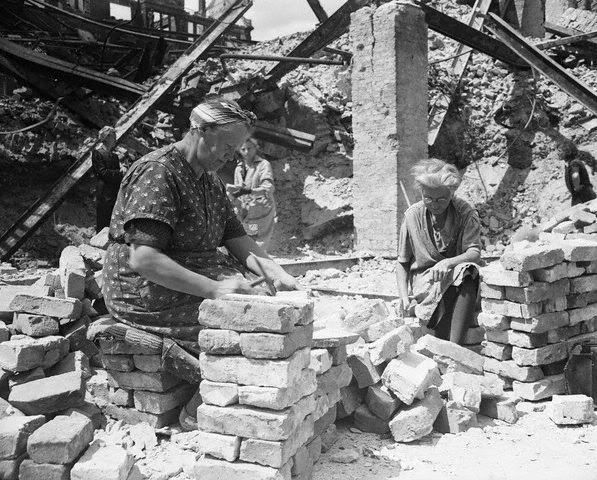
German women doing their part in helping rebuild Berlin. It would be many years before Berlin would recover from the war-times destruction, but it could not have been done without the hard work of many of its citizens. 

Finally, the third aspect of Berlin history that I have found interesting includes East Berlin and the Berlin Wall. Berlin, 1961, construction of the Berlin Wall began. Its purpose was to separate East Berlin, communist Berlin, from West Berlin, capitalist Berlin and to keep refugees from fleeing to West Berlin. Berlin became “suspended between two regimes, two ideologies, two halves of the world.” East Berlin would exist under communist Soviet rule for several decades. Finally, on the night of November 9, 1989, Berliners began dismantling the Berlin wall. The bringing down of the wall and the opening of East and West Berlin put an “end to the cruelties of the Cold War.” That night in November was unplanned, unanticipated, and unknown to those running the country. It was a completely unexpected event that would change the world. Since that night of the destruction of the Berlin Wall, Berlin has been put back together as a city, and Germany as a country. As one interviewee states, “The division of Germany was all the division of Europe, and the unification of Germany was the unification of Europe.” With the destruction of the wall came a consolidation of East Berlin and West Berlin, and hostilities between the two was over. Further incorporation would take place as the German government would work to reintegrate the two halves of the city. While it is still possible today to tell East Berlin from West Berlin, the two have formed together to create one the most beautiful, thriving cities of Europe.

Ampelmännchen, or “little traffic light men” are one of few East Berlin symbols that have survived the unification of Berlin. These symbols can be found not only on traffic lights, but also on T-shirts, key chains, and the like as a commemorative and symbolic type item.


*All quotes are used from the Berlin History BBC Documentary
Word Count: 672

Monday, September 8, 2014

Martin Luther: Reluctant Revolutionary

Martin Luther quickly and almost unintentionally became a leading revolutionary of his time. His rise as a revolutionary was almost an accident on his part, as he did not realize how much of an impact his 95 theses would have. The Catholic Church felt attacked by Luther and he was quickly sought after by the church to be punished, later to be excommunicated. By this time, Luther, along with his 95 theses, a “revolutionary manifesto”, had already begun a religious revolution. Thousands of people read his sarcastic, yet witty, rousing, and inspiring writings and began to follow his beliefs, steering away from the Catholic Church. Luther quickly obtained a large following. However, in the winter of 1520, Martin Luther was excommunicated by the church and in 1521 traveled to the city of Worms for a hearing which would determine his fate. On his journey to Worms, Luther was able to witness the true impact his 95 theses had had. The city of Erfurt held a party for him, and citizens of Frankfurt presented him with gifts. It was becoming clear to Luther how widespread his revolution had become. It was also becoming clear how much of a religious revolutionary Luther himself had become. His cultural, political, and religious revolutionaries were an extremely important event in the history of Germany, and one that can be seen in many positive ways. It challenged the church, which had a lot of power at the time. With opposing forces and challenging beliefs, both the church and the revolutionaries had to fight for their beliefs, resulting in stronger and more determined followership for both sides. Without the opposing force of Martin Luther and his followers, the Catholic Church would be unchallenged, free to do what they thought was best, which may not have been best for many of their followers. To compare to modern times, Luther’s revolution can be seen as somewhat of a checks and balances for the Catholic Church, meaning Luther was the one who assured the Catholic Church was staying in line and acting in a proper manner.


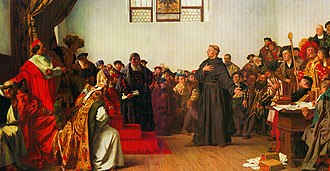
This painting is a depiction of Martin Luther at the Edict of Worms in 1521, where his fate would be determined by head political and religious leaders, with Emperor Charles V presiding.
Martin Luther is shown burning the papal bull of excommunication, an official letter informing Luther that he has been excommunicated by the church. On the outside are paintings of other major figures from the Protestant Reformation.


I believe Martin Luther was important to German-speaking lands because he was one of few religious revolutionaries who were brave enough to stand up against the church; to point out that what they preached had possible flaws. He allowed others to see that there were other ways to see things, and that the people had the ability to obtain, create, and form their own views and beliefs. Martin Luther was also the revolutionary for new religions which would spread world-wide, having an impact on thousands of people throughout the world. These religions had such strong followership that they still exist in large numbers today.


The Luther Rose, a symbol of Lutheranism.
Martin Luther nailing the 95 theses to the door of the All Saints' Church in Wittenburg on October 31, 1517.

As one interviewee from “Martin Luther: Reluctant Revolutionary” states, “The emphasis on the individual, the courage of the individual, and the willingness of the individual, to undergo death for his profession, for his beliefs, in this way, Luther has to be ranked with the great emancipators of human history.” His creation of emancipation from the grip of the Catholic Church, for some, led Martin Luther to be known as a religious revolutionary who is comparable to other great emancipators of our world’s history.


Word count: 628

Wednesday, August 27, 2014

The Thirty Years' War

German history, for many, may be thought of as an extremely sensitive, yet complex topic. The Second World War left a sour taste for many when thinking of Germany and its’ past. However, like nearly all other parts of the world, Germany has experienced times of peace and times of turmoil. Of course, as we have learned from our world’s history, extended peacetime tends to be rare. War is almost always occurring somewhere in the world. Between the years 1555 and 1618, while other parts of Europe were plagued by war, Germany experienced its longest period of peacetime in its history. Sixty three years of no war was brought to an end when tensions between the Protestants and Catholics became too much. “Out of this conflict developed a war that spread far beyond the borders of the empire . . . The aim of this Thirty Years’ War – actually a succession of several wars – was to restore the Catholic unity of Europe with the aid of the mighty Hapsburg and Wittelsbach dynasties” (Schulze, 63).  Although Germany had just gone through its longest period with no wars, it was now facing a period of thirty years, 1618 through 1648, which would go down in history as one of the most damaging eras in the history of Europe. By the end of the Thirty Years’ War, the population of Germany had decreased from 17 million to 10 million people (Schulze, 64).  The Thirty Years’ War shows that Germany is just like every other nation in the world; it cannot escape the strangling grasp of war. At the conclusion of the Thirty Years’ War, the European community of nations was developed. “It had taken the devastating, all-encompassing war to convince the nations of Europe that in the long run the only way to prevent ongoing universal strife was a political order that included everyone” (Schulze, 64). This organization of nations, constituted by the Peace of Westphalia, was a unification similar to what Europe has today, the European Union. Personally, I find this association of nations extremely contemporary for its time. To think that in the 17th century, Europe was able to successfully form this community of nations and establish the European nation-state system, is quite impressive to me. Also, relating to the first point in this entry, Germany may be seen by many as a warmongering nation due to its unfortunate history (specifically speaking of World War II and the Nazi Party), but that is not the case. Germany is like every other country in the world; it goes through its own history of peace, war, growth, turmoil, and progression. History shows that Germany does not have such a malicious past as some, unfortunately, might think.


A painting of the Battle of Lützen, which took place on November 16, 1632. It was one of the most decisive battles of the Thirty Years' War. Gustavus Adolphus of Sweden, a Protestant leader, was killed in the battle. While the battle was a Protestant victory, the death of an important leader would result in the downfall of the Protestant movement.


The Peace of Westphalia, which ended the Thirty Years' War, was negotiated at Münster and Osnabrück. Here is a depiction of its signing in 1648.


Word count: 453

Tuesday, June 3, 2014

Why Germany?

In my nearly 21 years, I have never stepped foot out of the continental United States. I am ready for an adventure across the world; an adventure that I hope will help me develop as a person, both culturally and intellectually. I know this may be a once-in-a-lifetime opportunity for myself, so I am taking full advantage. I also have a secret love for history. Starting in middle school, I became obsessed with World War II. I loved learning about the war and would take every possible opportunity to enhance my historical knowledge. The number of history books I have read is absurd, documentary watching could have been considered my part-time job, and my dreams of eventually visiting the land of World War II were plentiful. Those dreams are finally coming true. In just six months’ time, I will be in a country rich with history and culture that has held my interest for much of my life. I will be visiting cities which held momentous events of World War II, and will visit significant landmarks from the country’s history. Landmarks such as the Reichstag, the Brandenburg Gate, and the Berlin Wall will be a few among many on my list of sights to see.


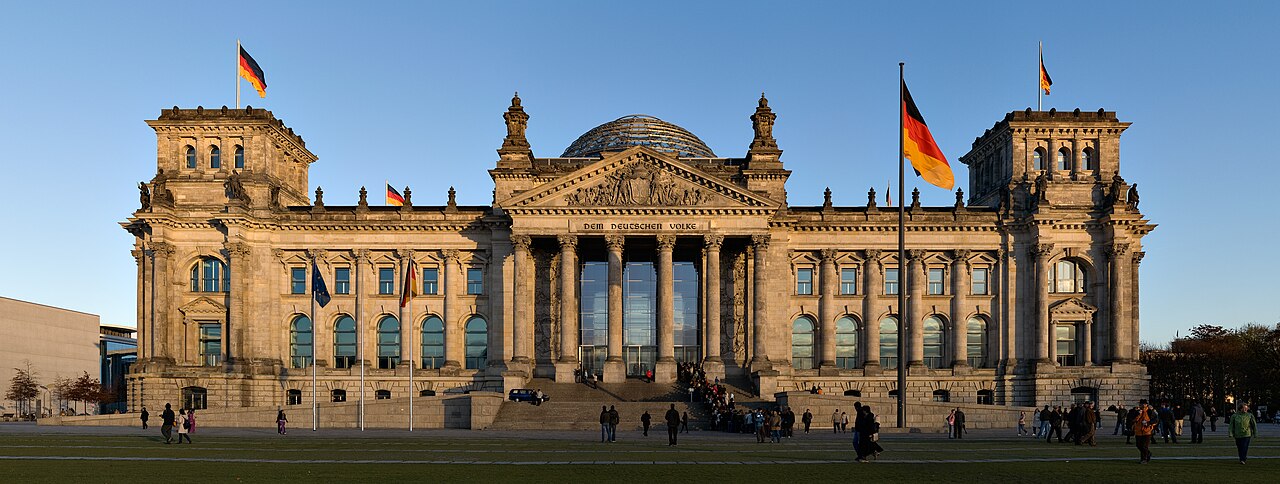
The Reichstag, current meeting place of the German Parliament, is pictured above. The bottom photo, from 1945, displays a Red Army soldier hoisting the hammer and sickle flag on top of the Reichstag building, signifying the seize and control of Berlin. The end of the Second World War would follow soon after. I greatly appreciate this photo because it is demonstrating just how close the end of the war is; Berlin has been occupied by the Soviets and the Germans are on their last stand.

During my time in Germany, I anticipate to further enhance my knowledge of the country’s deep history and culture. I hope to come away from this trip with a much more well-rounded understanding of Germany’s history, since I have focused almost solely on World War II in my personal studies. I expect to be well informed on topics such as Martin Luther, World War II, the division of Germany, and the unification of East and West Germany, as well as the development of religious architectural styles throughout the country. That brings me to my next reason for choosing Germany. Architecture is yet another topic which I have much interest in. The unique styles and designs of German castles and cathedrals are absolutely fascinating to me. Pictured below is the Erfurt Cathedral (left) and St. Severus Church (right), both of which I hope to visit. I believe they are both beautiful structures that can only be truly appreciated in person.


I am beyond excited for our time in Germany. Beyond the educational experiences I will obtain, I hope to simply have a great time, in a great country, with some great people. I am very much looking forward to our three months together in Germany.

Until then.

Zum Wohl!


Word Count: 498