The history of Germany’s government
is an extensive and complex one. Leadership roles, the political structure, and
the variety of political parties varied drastically throughout the nineteenth
and twentieth centuries. However, Germany’s identity would not be what it is
today without these numerous changes throughout its history. Hagen Schulze
described that “In the German political tradition, parties were symbols of
narrow special interests, political infighting, and threats to national unity”
(Schulze, 191). During the First World War, the Weimar Republic was formed,
creating the first democracy of Germany. Following World War I, a political war erupted
as political parties struggled for power. Hagen Schulze wrote, “After Germany’s
collapse, the situation was volatile, with three different factions vying for
power” (Schulze, 198). The Treaty of Versialles, created by the Allied forces,
set Germany upon a destructive course politically and economically. With the
treaty, “Germany was placed under legal sanctions, deprived of military power,
economically ruined, and politically humiliated” (Schulze, 204).
 |
| The Coat of Arms of Germany between 1919 and 1928, the period during which the Weimar Republic controlled. |
Throughout the late 1910’s and
early 1920’s, Germany’s political party system frequently went through changes.
The SPD, Center Party, DDP, DVP, and several other political parties witnessed
the recurrent change of governments. Hagen Schulze wrote, “The republic
experienced a succession of sixteen different governments, on the average a new
one every eight-and-a-half months” (Schulze, 207). However, the “golden years”
of the Weimar Republic would soon approach, a period with little political conflict.
Schulze described that this positive tone of the era was due to new governments
in both Britain and France, which were much more open to German wishes and
hardships. “With these measures, the long, dark shadow of the postwar years . .
. finally receded. The catastrophe had lasted from 1914 to 1923, but now
Germany and Europe as a whole were emerging from the darkness and entering into
a long period of peace and returning prosperity” (Schulze, 212-3).
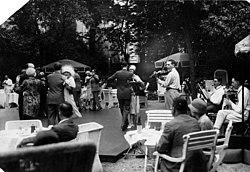 |
| A jazz band plays for a tea dance, 1926, Berlin. The time period known as the "golden years". |
Germany and the rest of Europe
entered a period of peace that would last until the next decade. Between 1924
and 1929, German production increased in volume by 50 percent. Unfortunately,
other sections of Germany’s economy did not fare as well. The gross national
product would not reach the prewar level of 1913 until 1927, when it only began
to decline again. The unemployment rate was much higher than the prewar years,
and “labor productivity figures stagnated, without ever returning to prewar
levels” (Schulze, 219). Eventually, in 1930, Chancellor Hermann Müller resigned from his
position, leading to the last parliamentary government of the Weimar Republic
to come to an end. Hagen Schulze described by writing, “The failure of the
republican parties to reach a workable consensus was symptomatic of the overall
political collapse of the republic, which broke apart into factions at war with
one another” (Schulze, 230). A new party would soon enter the playing field of
the German political realm; one which would attract a vast following but also
lead to Germany’s central role in the Second World War.
 |
| Hermann Muller, 12th Chancellor of Germany. His resignation would lead to the last parliamentary government of the Weimar Republic to come to an end. |
Adolf Hitler’s National Socialist
German Workers’ Party (NSDAP) would pick up steam throughout the 1930’s,
gathering more and more of a following, young and old. “On January 30, 1933, he
[Hindenburg] appointed Hitler chancellor, sounding the death knell for the
republic of Weimar” (Schulze, 243). The Weimar Republic was dead after a
fourteen year control and by mid-1933, “only one party existed in Germany, the
party of Adolf Hitler” (Schulze, 249). Hitler’s Nazi Party would quickly begin
their reign over Europe, starting military actions in 1939, the beginning of
World War II. The war was not all good for Germany and its people. Hagen
Schulze explained,
The war intensified the tendencies
of the totalitarian state, bringing with it a militarization of public life,
increasing organization of the formerly private sphere, and social leveling . .
. There were appeals to solidarity within the ‘community of the people’; party
and state organizations were created that included virtually every citizen in
the end; block wardens kept an eye on their neighborhoods, and neighbors were
encouraged to spy on one another.(Schulze, 270)
World War II caused many changes in Germany. At the end, yet
another German political party saw its death. Germany and its people now faced
a long period of reconstruction, in physical, mental, and political form. The nation
would be divided between the four major allied powers, and would face centuries
of division between themselves. Overall, Germany has gone through an almost
countless number of political changes throughout its history. Without the political
structure and the party system’s drastic changes throughout its history, Germany would not be the nation it is today.
 |
| The emblem of the NSDAP, the Nazi Party |
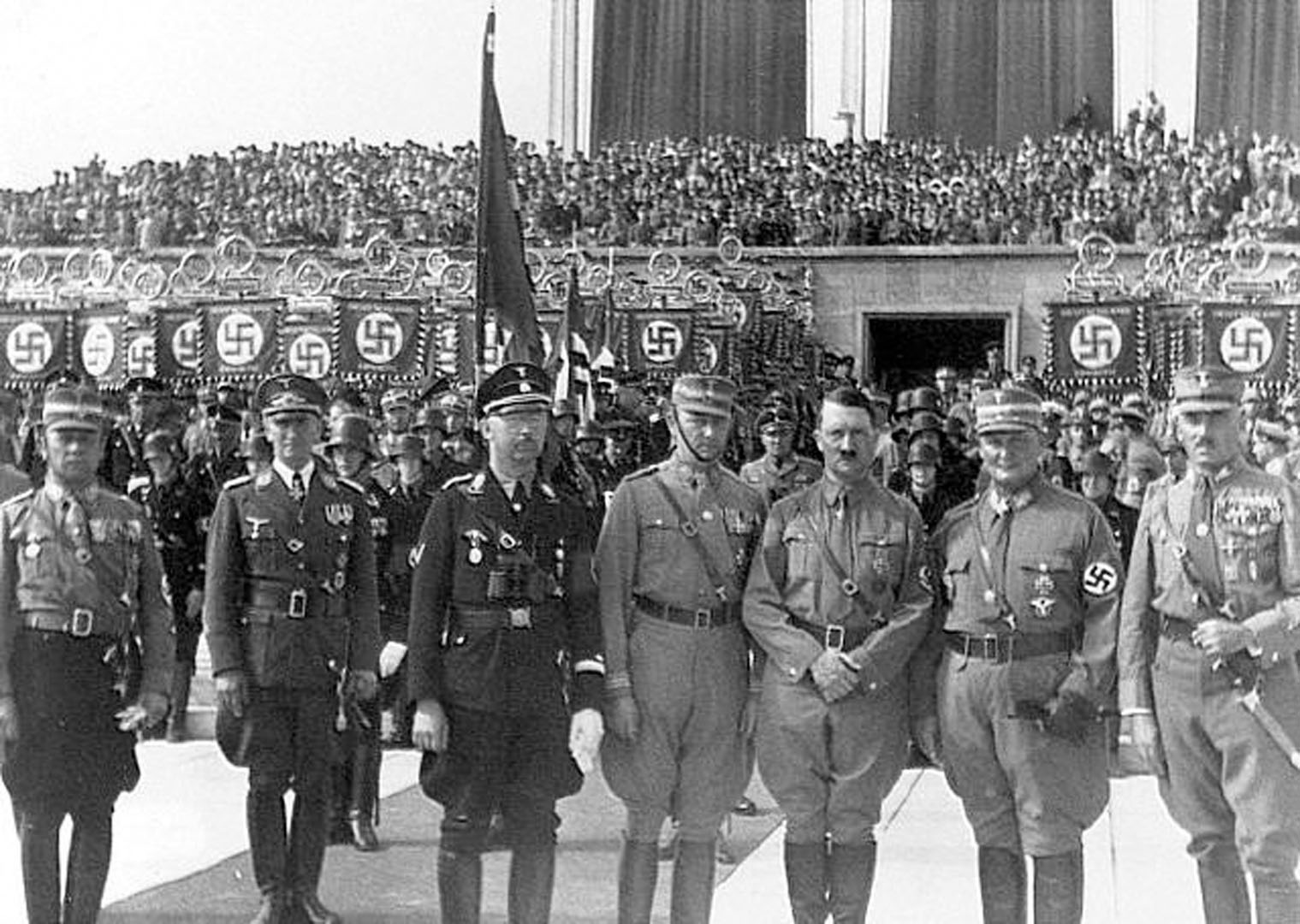 |
| Hitler along with other Nazi officials, including Goering and Himmler at a Nazi Party Rally in Nuremberg. |
Word Count: 763

No comments:
Post a Comment