The German state was founded over a
broad period of time which consisted of several wars, leadership disputes,
dynasty battles, border conflicts, and many other quarrels. It wasn’t until
1871 when the German state was ultimately founded. However, there are records
of there being an idea of a German state as early as the seventeenth century,
when in 1656 political philosopher Ludwig von Seckendorff declared that “a ‘German
nation’ existed in the political sense” (Schulze 86). Additionally, “In the seventeenth and
eighteenth centuries ‘German’ still referred only to a language, nothing more,
and at times even the prospects for its future were murky (Schulze, 86). Hagen
Schulze described in Germany: A New History
that the national boundaries in Europe shifted so often, as a result of major
wars, that whole provinces and even empires changed hands (Schulze, 81). This “shifting
of hands” is a compelling issue which led to Germany’s vast cultural and
political diversity that would evolve throughout the seventeenth, eighteenth,
and nineteenth centuries. Also, various wars during the 18th century,
including both the first and second Silesian Wars and the Seven Years’ War,
altered the path of Germany’s future. “After the Seven Years’ War, it might
have appeared as if the world of German states had broken free from the empire
to a large degree and caught up with their neighbors in the European system as
sovereign powers capable of political action” (Schulze, 84). These small states
and their distinctiveness are what led to Germany’s complex and distinguishing identity
today. Hagen Schulze writes, “The nation grew, in fact, precisely because of
its fragmented identity and the practical requirements of a multitude of small
states and governments” (Schulze, 89). German identity would only evolve more
as the nation grew.
 |
| The Battle of Hochkirch, October 14, 1758 during the Seven Years' War. |
Early in the nineteenth century, on
July 12, 1806, sixteen states in south and southwestern Germany signed an act
which abolished any connection they had with the empire and established a
protectorate under Napoleon (Schulze, 99). This act may be seen as one of the major
points in Germany’s history. Before this point, Germany had been doubtful
without the protective covering of the empire. The French were now making their
way through Germany, causing devastation as they pillaged the land. Philosopher
Johann Gottlieb Fichte delivered his “Addresses to the German Nation” in
occupied Berlin during the winter of 1806-1807. In the addresses, he declared that
“the nature of the German people was genuine and unspoiled, and that by
fighting for their own identity and freedom from French military and cultural
domination, Germans were serving the cause of progress” (Schulze, 104-5). During
this time, Germans were fighting for their identity; their identity which had
been continuously undefinable. War would eventually cease, following the Wars
of Liberation in 1813 and 1815, and Germany would enter a phase called Biedermeier. This period lasted two
decades and was a time when there was no war in Europe.
 |
| Napoleon Bonaparte (1769-1821), Emperor of the French and de facto ruler of all western and central Europe. |
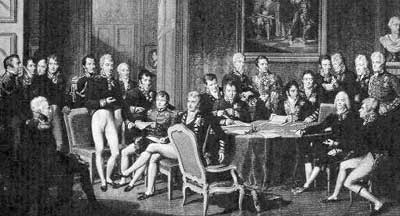 |
"A Break in Negotiations at the Congress of Vienna: In the fall of 1814 representatives of the European nations met in Vienna to decide on a new order for Europe - including Germany - after Napoleon's downfall."
|
 |
| A German Reading Room. During the phase called Biedermeier, literacy rates rose to nearly half - "a true revolution." |
In 1840, there was a “rebirth of
German nationalism and strong growth in the organizations promoting it”
(Schulze, 119). On October 10, 1847, “leaders met in Heppenheim and issued a
demand for a federal German state with a strong central government that would
be answerable to parliament” (Schulze, 121). Later, on May 18, 1848, “the
German National Assembly – 585 elected representatives – convened in Frankfurt
to draft and adopt a constitution that would guarantee basic freedoms and to
elect a national government” (Schulze, 124). One problem that arose during this
time was deciding which regions would be part of the new Germany. Two possible
solutions emerged; one being Groβdeutschland,
“Great Germany,” which would consist of all German regions including Austria
and be headed by a Hapsburg emperor. The second solution was called Kleindeutschland, “Small Germany.” This
would exclude the Austrian areas and be ruled by a Hohenzollern emperor. Unfortunately,
the Revolution of 1848-49, for the most part, would eventually fail. However, the
following two decades would consist of another rebirth of German nationalism.
The German National Association (Small Germany) and the German Reform
Association (Greater Germany) were formed in 1859 and 1862, respectively. Then,
in 1866, war ended. Schulze explains “The war that ended at Koniggratz has been
seen in retrospect . . . as a step toward German unity (Schulze, 141). The Treaty
of Prague ejected Austria from Germany and created the North German
Confederation. The Franco-Prussian War of 1870-71 would lead to German victory,
concluding on May 10, 1871. “Political unification of the allied German states
proceeded in tandem with the events of the war” (Schulze, 144). Finally,
southern Germany joined the North German Confederation and formed a German
Empire.
German unification by no means came
about solely on orders from above, from the ruling princes and their
governments, but also as a result of clamor from below, from the forces of the
liberal, middle-class national movement, and the result was accordingly not a
Great Prussia but a German Empire. (Schulze, 145)
 |
| The German National Assembly - 585 elected representatives - convened in St. Paul's Church in Frankfurt to draft and adopt a constitution that would guarantee basic freedoms and to elect a national government. |
Overall, Germany faced many challenges in its three-century
long bout for creation. Wars, conquests, and sovereignty discrepancies led to
slow progress for Germany’s founding. However, it was the “forces of the
liberal, middle-class national movement” that would preserve Germany’s identity
as it was, and who would help permanently establish the German Empire. What was
formed was a complex, diversified, and distinctive Germany that has been
constantly evolving for hundreds of years, creating the Germany that we know today.
 |
| Classical-style German architect Karl Friedrich Schinkel's Neues Schauspielhaus ("New Theatre") in Berlin; now the Konzerthaus Berlin. |

No comments:
Post a Comment