Martin Luther quickly and almost unintentionally became a
leading revolutionary of his time. His rise as a revolutionary was almost an
accident on his part, as he did not realize how much of an impact his 95 theses
would have. The Catholic Church felt attacked by Luther and he was quickly
sought after by the church to be punished, later to be excommunicated. By this time,
Luther, along with his 95 theses, a “revolutionary manifesto”, had already
begun a religious revolution. Thousands of people read his sarcastic, yet
witty, rousing, and inspiring writings and began to follow his beliefs,
steering away from the Catholic Church. Luther quickly obtained a large
following. However, in the winter of 1520, Martin Luther was excommunicated by
the church and in 1521 traveled to the city of Worms for a hearing which would
determine his fate. On his journey to Worms, Luther was able to witness the
true impact his 95 theses had had. The city of Erfurt held a party for him, and
citizens of Frankfurt presented him with gifts. It was becoming clear to Luther
how widespread his revolution had become. It was also becoming clear how much
of a religious revolutionary Luther himself had become. His cultural, political,
and religious revolutionaries were an extremely important event in the history
of Germany, and one that can be seen in many positive ways. It challenged the
church, which had a lot of power at the time. With opposing forces and
challenging beliefs, both the church and the revolutionaries had to fight for
their beliefs, resulting in stronger and more determined followership for both
sides. Without the opposing force of Martin Luther and his followers, the
Catholic Church would be unchallenged, free to do what they thought was best,
which may not have been best for many of their followers. To compare to modern
times, Luther’s revolution can be seen as somewhat of a checks and balances for
the Catholic Church, meaning Luther was the one who assured the Catholic Church
was staying in line and acting in a proper manner.
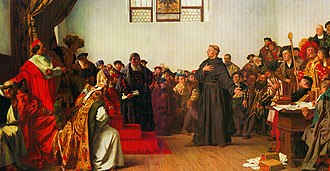 |
This painting is a depiction of Martin Luther at the Edict
of Worms in 1521, where his fate would be determined by head political and
religious leaders, with Emperor Charles V presiding.
|
 |
| Martin Luther is shown burning the papal bull of excommunication, an official letter informing Luther that he has been excommunicated by the church. On the outside are paintings of other major figures from the Protestant Reformation. |
I believe Martin Luther was important to German-speaking
lands because he was one of few religious revolutionaries who were brave enough
to stand up against the church; to point out that what they preached had possible
flaws. He allowed others to see that there were other ways to see things, and
that the people had the ability to obtain, create, and form their own views and
beliefs. Martin Luther was also the revolutionary for new religions which would
spread world-wide, having an impact on thousands of people throughout the
world. These religions had such strong followership that they still exist in
large numbers today.
 |
| The Luther Rose, a symbol of Lutheranism. |
 |
| Martin Luther nailing the 95 theses to the door of the All Saints' Church in Wittenburg on October 31, 1517. |
As one interviewee from “Martin Luther: Reluctant
Revolutionary” states, “The emphasis on the individual, the courage of the individual, and the willingness of the individual, to
undergo death for his profession, for his beliefs, in this way, Luther has to
be ranked with the great emancipators of human history.” His creation of
emancipation from the grip of the Catholic Church, for some, led Martin Luther
to be known as a religious revolutionary who is comparable to other great emancipators
of our world’s history.
Word count: 628
Word count: 628

No comments:
Post a Comment